

HOW TO USE THE ABC VALUE TO IMPROVE YOUR BROILER FEED
Ever heard about the meaning of the ABC value of your broiler feed?
…if no, then you are far from alone. Unfortunately, ABC values are still rarely calculated or communicated to poultry producers, despite the increasing focus on gut health, feed efficiency, and antibiotic-free production.
In this article, we explain why broiler producers should be familiar with the ABC values of their feed.
WHAT IS THE MEANING OF THE ABC VALUE?
ABC stands for Acid Binding Capacity. The ABC value is measured relative to a pH of 3 or 4 and is denoted ABC-3 (at pH 3) or ABC-4 (at pH 4).
The ABC value tells you how much hydrochloric acid, in milli-equivalents, the broilers need to secrete to reduce the pH of 1 kilo of feed to pH 3 or an ABC-4 to pH 4.
You can use both values for broiler feed, but since broilers need a lower ABC value than pigs due to differences in the digestive tract, we will use ABC-3 going forward.
At pH3, protein digestion is optimised, as the enzyme pepsin becomes active and harmful bacteria are suppressed.
The higher the ABC-3, the more acid the broiler must secrete to lower pH and activate protein digestion.
And here’s the point and the problem:
In young broilers, acid secretion capacity is still developing. This means that feed with a high ABC-3 can keep the gut pH too high, limiting pepsin activity and allowing more undigested protein to pass into the intestine (Figure 1).
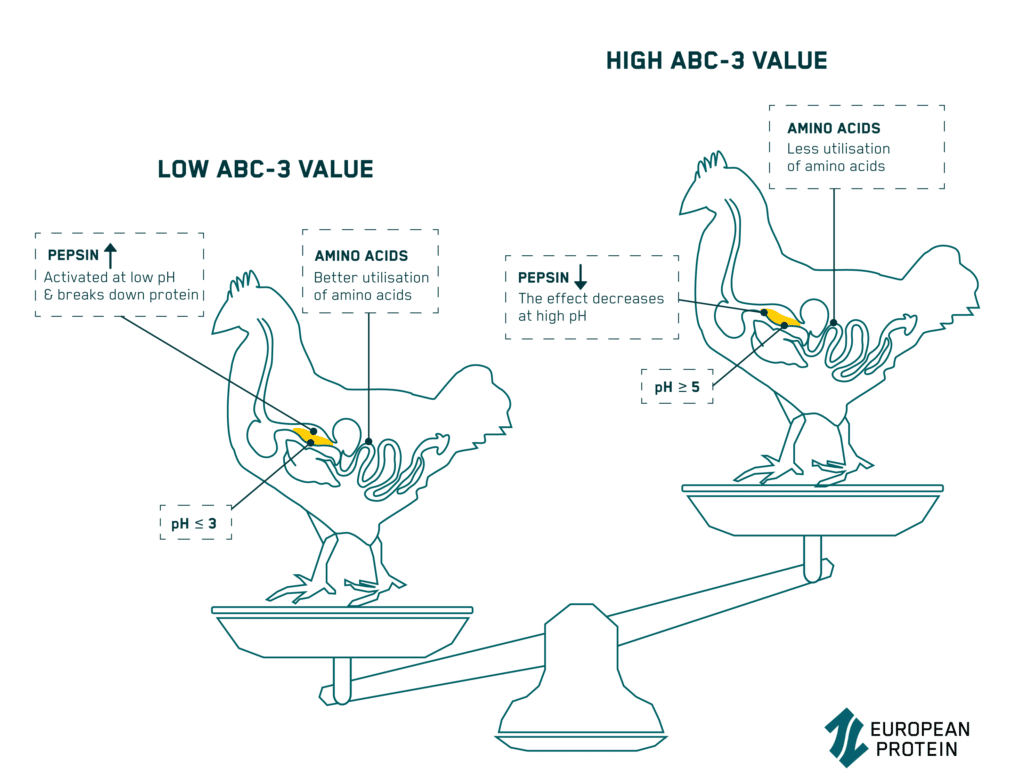
Figure 1: A low ABC-3-value in the broiler feed contributes to improved protein digestion
The broiler relies on hydrochloric acid to reduce the proventriculus (glandular stomach) and activate pepsin, which breaks down proteins into peptides. However, especially in the starter phase, the bird’s ability to acidify the digesta is limited.
If the buffering capacity of the feed is too high, protein digestion becomes less efficient, and more nutrients remain undigested.
This undigested protein can reach the lower gut, where it becomes a substrate for undesirable bacteria, increasing the risk of gut imbalance and reduced performance.
For this reason, controlling the ABC-3 of the diet is directly linked to improved nutrient utilisation and gut health.
FEED COMPOSITION STRONGLY INFLUENCES PH
The composition of broiler feed has a major impact on pH.
Protein-rich diets are essential for growth, but many commonly used protein sources—especially soybean meal—have relatively high ABC-3 values. This means that while they supply essential amino acids, they can also increase acid binding capacity, making it more difficult for the broiler to reach optimal digestive conditions.
As a result, there is often a trade-off between nutritional density and digestive efficiency if ABC is not taken into account.
MINERALS ARE AMONG THE STRONGEST DRIVERS OF HIGH ABC
Some of the most significant contributors to high ABC-3 values are mineral sources.
Limestone, widely used as a calcium source, has a very high buffering capacity and can significantly increase gut pH if included at high levels. While calcium is essential for skeletal development and growth, excessive mineral buffering can compromise digestion.
This makes it important not only to consider nutrient levels, but also the form and source of those nutrients when formulating broiler diets.
CHECK THE ABC VALUE OF YOUR FEED
With increasing pressure to reduce antibiotic use and optimise feed efficiency, more nutritionists are incorporating ABC values into their formulation strategies.
However, this parameter is still not always transparent.
If you want to better understand your feed’s impact on gut health and performance, ask your feed supplier or nutritionist whether the ABC-3 value of your broiler diet is known and optimised.
Even small improvements in buffering capacity can translate into measurable gains in feed conversion and growth.
HOW TO LOWER THE ABC VALUE OF YOUR BROILER FEED
If you want to reduce the ABC-3 of your feed, there are several options.
Reducing crude protein levels can lower acid-binding capacity, but this may limit growth performance if not carefully balanced with amino acids.
Adding organic acids can help compensate for limited acid production, but this increases feed cost and may have variable effects depending on the type of acid, inclusion level and diet composition.
Another approach is to select raw materials and protein sources with inherently lower ABC values. This allows you to maintain nutritional quality while improving the overall digestive environment.
MAJOR DIFFERENCES IN ABC-3 FOR SOY PROTEIN
Most broiler producers rely heavily on soy-based proteins in starter and grower diets. It is often assumed that different soy products have similar effects on digestion and that ABC values are mainly driven by protein content.
This is only partly true.
Processing methods significantly affect the ABC-3 value of soy protein. Standard soybean meal and, in particular, refined soy protein increase the feed’s buffering capacity.
In contrast, fermented soy products, such as EP200, have a lower ABC-3 value and can reduce the diet’s overall buffering capacity.
As a result, soy proteins behave differently in the digestive tract, even if their nutritional compositions appear similar on paper.
Table 1 shows differences in ABC-3 for soybean meal, fermented soy (EP200), enzymatically treated soy protein and extruded soy protein.
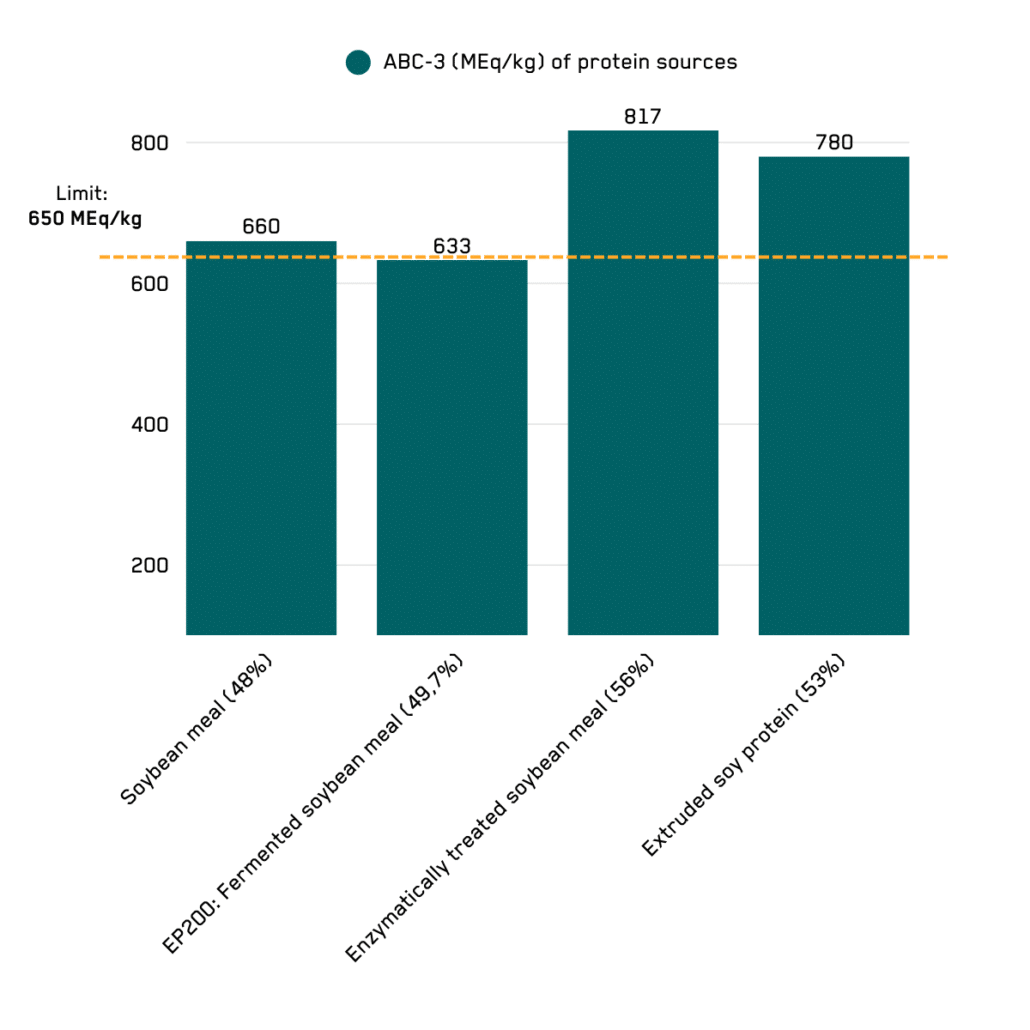
Tabel: Overview of the ABC-3 of different types of soy protein for broiler feed
Each of the green columns represents how much the protein source contributes to increasing or decreasing the acid-binding capacity (ABC-3) in your prestarter and starter feed.
Lacto fermented soy protein, EP200, lowers the ABC-3 of your broiler feed, while enzymatically treated soy and extracted soy both increase the ABC-3 value.
You can also find examples of refined soy protein where the minerals are removed to lower the ABC-3 of the feed. But broilers need minerals, so you will have to add extra minerals through your premix supplier.
The yellow line shows the recommended level of no more than 650 mEq/kg in the total broiler feed.
WHY ABC MATTERS IN BROILER FEED
A lower ABC-3 value in broiler feed supports a lower gizzard pH, which improves protein digestion and reduces the amount of undigested nutrients entering the intestine.
This contributes to a more stable gut environment, better nutrient utilisation, and improved performance.
Importantly, this can often be achieved without increasing feeding costs, simply by making more informed choices about raw materials and processing methods.
TAKEAWAY
The ABC value is an underutilised but highly relevant parameter in broiler nutrition.
By managing the acid binding capacity of your feed, you can support digestive efficiency, gut health, and overall performance—especially in the critical early stages of life where the digestive capabilities are not yet fully established.
Understanding and optimising ABC-3 is therefore not just a technical detail, but a practical tool for improving results in modern broiler production.

